Your Old Kilim Deserves Better Than a Closet — We Turn Them Into Ottomans, Benches, and Upholstery-Kilim upholstery Boulder Colorado
You have a kilim somewhere.
Maybe it came back from a trip to Turkey or Morocco fifteen years ago. Maybe it was your grandmother's. Maybe you bought it at an estate sale because something about it stopped you cold — the colors, the geometry, the feeling that it was made by someone who knew exactly what they were doing — and you couldn't walk away from it.
And now it's rolled up in a closet. Or folded in a cedar chest. Or laid flat in a guest room where nobody really sees it, doing nothing, being nothing, waiting.
That kilim deserves better. And we can give it better.
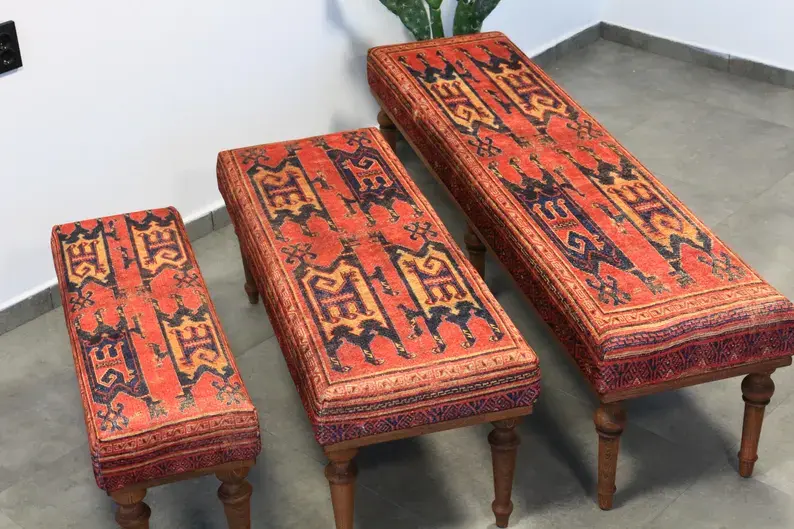
At Boulder Rug Collective, we now offer a full kilim and tribal rug upholstery service — turning your old flatweaves and rugs into handcrafted ottomans, benches, chair upholstery, pillows, and floor cushions. Commissioned through our specialist upholsterer Yusuf, built around the specific textile in front of us, unique every single time.
If you have a kilim and you're not sure what to do with it — call us. That's what this service is for.
Kilim Upholstery Is Not a New Idea — It's a Return to One
Before kilims became collectible floor coverings, before they started appearing in interior design magazines and high-end showrooms, they were utility objects. Made by nomadic and village weavers across Turkey, the Caucasus, Persia, and Central Asia, kilims served as floor coverings, yes — but also as tent walls, sleeping surfaces, saddle covers, storage bags, door hangings, and seating covers.
The kilim was always meant to be lived with, not preserved under glass. Turning your kilim into an ottoman or a bench cover is not a modern repurposing idea. It is a return to the way these textiles were always used — functional, tactile, present in daily life rather than rolled away from it.
The geometry of kilim design was made for upholstery. A bold medallion centers perfectly on an ottoman face. A repeating border pattern wraps naturally around a bench edge. A strong all-over geometric field covers a chair seat in a way that transforms the entire piece of furniture. The flat, tight weave of a kilim holds its shape under regular use in a way that pile rugs cannot — making it one of the most naturally suited textiles for upholstery work that exists anywhere.
What We Can Make
Every commission starts with the textile itself — its dimensions, its condition, its design, and what sections are strongest. From there, the possibilities are wide.
Large Ottomans
The most dramatic transformation we offer. A substantial kilim — or the best sections of one — wrapped over a custom ottoman form creates a piece that anchors a room the way nothing else can. Bold geometry on a large horizontal surface. Colors that bring the floor and the furniture into conversation. The kind of statement piece that every interior designer in Boulder is looking for and almost nobody can source.
A large kilim ottoman is not a craft project. It is a serious piece of furniture built around a serious textile, and Yusuf at Astratex approaches it accordingly.
Benches
Kilim-upholstered benches are one of the most versatile and functional results of this service. At the foot of a bed. In an entryway. Along a dining room wall. A well-made kilim bench brings color, pattern, and handmade character into spaces that often have none — and it does it in a form that is completely practical, completely durable, and completely unique.
The kilim's tight flatweave construction is particularly well suited to bench upholstery — it handles the compression of regular seating without losing its structure or its visual impact.
Chair Reupholstery
Have a chair that has lost its fabric and its personality? A dining chair that needs recovering? A reading chair that could use a completely new life? Kilim fabric is among the most extraordinary upholstery material available anywhere — flat, tight, visually powerful, and far more durable under use than most decorative fabrics.
We can commission Yusuf to reupholster your existing chairs with kilim fabric from your own collection, or with material we source for you from our inventory. The result is a piece of furniture that becomes genuinely one of a kind — your chair, your kilim, your room.
Pillows and Floor Cushions
For smaller kilim fragments or for owners who want to start with something more modest, we also offer handcrafted pillows in all sizes — from accent cushions to large floor pillows — and generous floor cushions for low seating in living rooms, meditation spaces, or anywhere you want to bring the kilim down to the level where you can really feel it.
Custom Commissions
We don't work from a fixed menu. If you have a specific piece in mind — a window seat cover, a headboard panel, a stair runner section turned into a hall bench — bring the idea and bring the kilim. We'll work with Yusuf to figure out what's possible.
The Textiles That Work Best
Almost any kilim or tribal flatweave in reasonable condition is a candidate for upholstery work. Here's what we see most often — and what works best.
Turkish Kilims The most common flatweave in Colorado homes, often brought back from travel or inherited from family. Bold, clear geometric design that translates beautifully to upholstery scale. Usually in good structural condition even when they show age and wear.
Afghan and Tribal Flatweaves Beluch, Turkmen, and related tribal pieces with strong geometric vocabulary. The design density on Afghan flatweaves is particularly well suited to larger pieces — an ottoman or a bench gives the pattern room to be seen at the scale it deserves.
Persian Kilims More refined and sometimes more curvilinear than their tribal counterparts, Persian kilims bring an elegance to upholstery work that suits more formal interior settings. A Persian kilim chair is an extraordinary object.
Moroccan Flatweaves Berber weavings with organic, spontaneous geometry create floor cushions and ottomans with a relaxed, bohemian quality that suits the Colorado mountain aesthetic perfectly.
Rug Fragments This is perhaps the most exciting category. You may have a larger pile rug that is too worn for floor use — significant wear in the field, moth damage in one section, foundation issues at the edges — but still has a beautiful central medallion, a stunning border section, or a fragment of field that is completely intact. Those fragments don't need to go to waste. The best section of a worn rug can become the face of a spectacular pillow or the cover of a small ottoman. We assess every piece individually and tell you honestly what's possible.
What Condition Does the Kilim Need to Be In?
We get this question constantly and the honest answer is: it depends on what you want to make.
For large pieces — ottomans, benches, chair reupholstery — the kilim needs to be in at least partially sound structural condition across the sections that will become the visible face of the piece. Minor wear, slight fading, edges that show their age — all of that is fine and often adds character. What we need is structural integrity in the key areas.
For pillows and smaller cushions, we can often work with kilims in more compromised condition — finding the strongest section and building around it, even if the rest of the textile is beyond use.
Bring it in and we'll take an honest look. We've been working with tribal textiles for over two decades. We can tell you quickly what the possibilities are and what the realistic outcomes look like.
It Always Gets Cleaned First
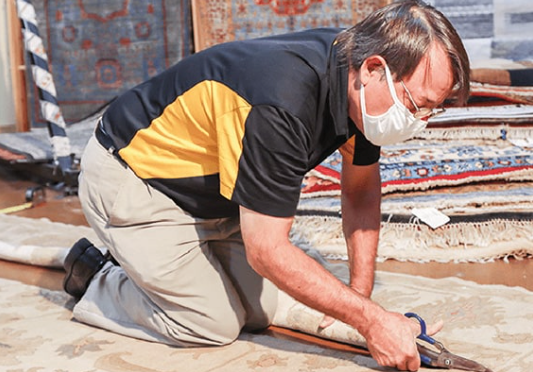
Before any kilim goes to Yusuf for upholstery work, it comes to Expert Rug Cleaning next door — same address, same team. Every piece gets professionally washed, dried, and inspected before the upholstery commission begins.
This is not optional and it is not an upsell. A kilim that has spent years in a closet or on a floor carries accumulated dust, embedded grime, allergens, and organic debris that you do not want sealed into a piece of furniture you sit on every day. The cleaning step is what ensures the textile arrives at Yusuf's workshop in the best possible condition — structurally sound, genuinely clean, and ready to be transformed.
The wash also reveals the true condition of the textile in ways that a dry inspection cannot. Colors brighten. Structural issues become visible. The full design emerges from under years of accumulated soil. More than once, a kilim that seemed modest before cleaning became extraordinary after it — changing what was possible for the upholstery commission entirely.
Why This Matters for Boulder
Boulder's design culture is built around authenticity, craft, and objects with stories. A kilim ottoman is all three simultaneously.
It is authentic — made from a textile that was woven by hand, by a specific person, in a specific tradition, with specific meaning embedded in its geometry. It is crafted — built by a specialist upholsterer who brings skill and care to every commission. And it has a story — your kilim, your history, your decision to give something beautiful a new life rather than let it disappear into a closet.
No showroom carries what we can make. No online retailer sells what comes out of this service. Every piece is one of a kind by definition — because every kilim is one of a kind, and every commission is built around the specific textile in front of us.
That's the point. And in a world full of mass-produced everything, that point matters more than ever.
Ready to Start?
Call us, come in, or bring your kilim. We'll look at it together, talk through the possibilities, and give you a clear picture of what we can make and what it will cost before anything moves forward.
Pricing depends on the complexity of the piece, the size of the commission, and the specific work involved. We'll quote you honestly before we begin.
Your kilim has been waiting long enough. Let's give it its next life.
📍 4919 Broadway St, Suite 8, Boulder, CO 80304
📞 970-970-0070


Comments