The Rug That Made Us Look Twice — An Afghan Kazak With a Story Worth Knowing-Persian rug cleaning Boulder CO

Some rugs are immediately legible. You look at them and you know exactly what you're looking at — the style, the origin, the tradition. They are beautiful and familiar and you appreciate them instantly.
And then there are rugs like this one.
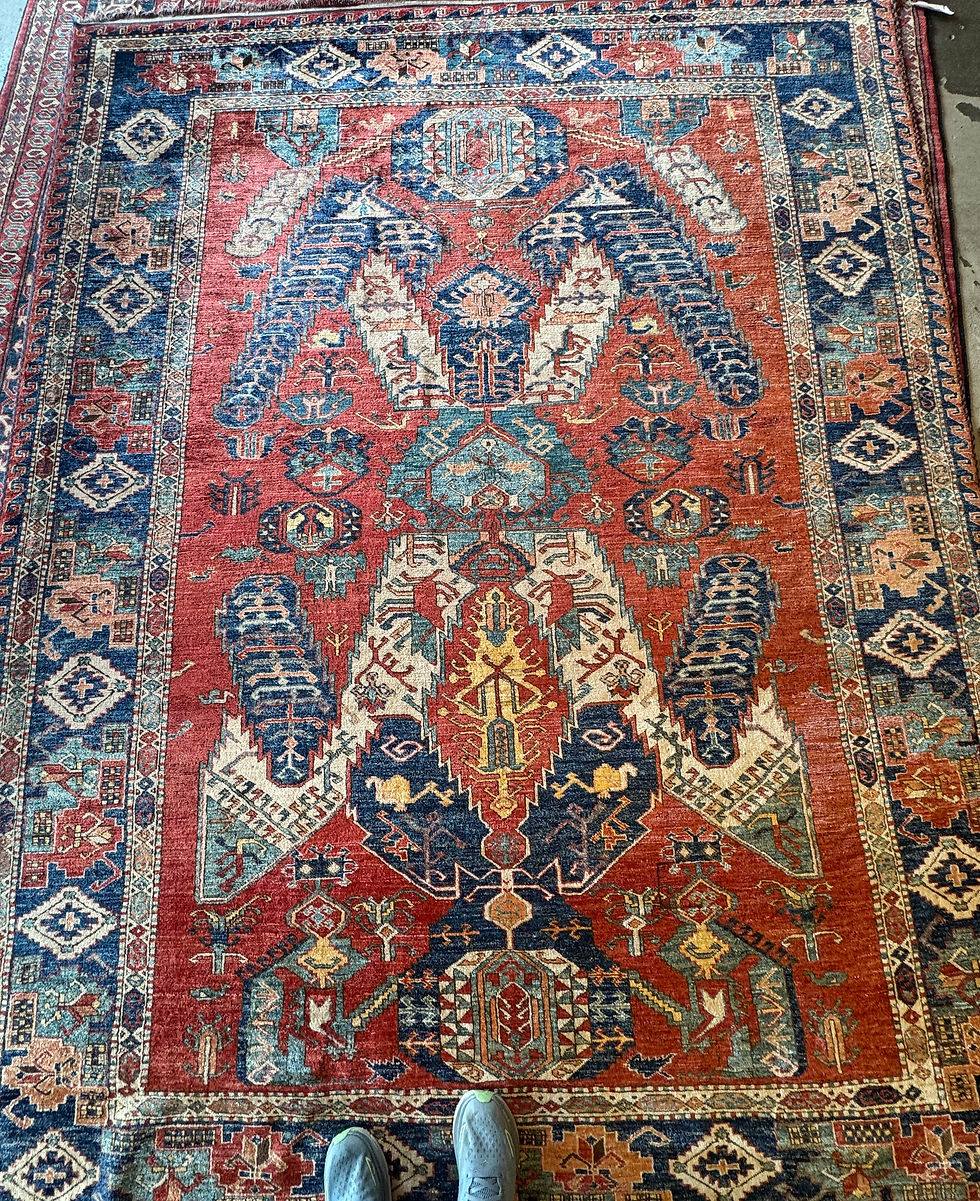
This Afghan Kazak came into our shop recently for professional cleaning and fringe repair — brought in by its owner, not for sale, just loved and in need of proper care. But before it went next door to Expert Rug Cleaning, it spent some time on our floor. And it created exactly the kind of conversation we love most.
Because this rug looks like one thing and turns out to be something richer, more specific, and more interesting than the label suggests.
Called a Kazak. But Not Quite Like Any Kazak You've Seen.
The first impression is immediate and clear. Rust-red field. Deep navy border. Bold geometric composition. Tribal energy in every element. Classic Kazak visual language — the kind of rug that has been stopping people in their tracks since Caucasian tribal weavings first reached European collectors in the 19th century.
But then you get closer.
The wool has a sheen that traditional Caucasian Kazaks don't possess. The knot density is tighter — more detail in the drawing, more precision in the execution of each motif. And those large central forms, the ones that read as medallions from across the room — on close examination they aren't medallions at all. They are stylized cypress trees. Geometricized, abstracted, transformed by the weaver's hand into angular architectural forms — but cypress trees nonetheless.
This is an Afghan Kazak. And that distinction matters.
What Is an Afghan Kazak — And Why Are They Different?
The Kazak style originated in the Caucasus mountains — woven by Armenian, Azerbaijani, and Kurdish tribal peoples in the high mountain villages of the southern Caucasus, in a region that now spans parts of modern Armenia, Georgia, and Azerbaijan. In weaving terms, Kazak is probably the most famous area in the Caucasus, for the best of the rugs produced there combined stunning geometric designs with fabulous colors derived from high-quality dyes — and perhaps because they were woven in the highest reaches of the towering Caucasus Mountains, they express a particularly cosmological character, exploring the intimate interplay between heaven and earth. Artistseyestudio
But the story didn't stay in the Caucasus. Conflict and displacement in the region led many Caucasian weaving families to migrate further east, and as a result Kazak-style rugs are now predominantly knotted outside their historical origin area — especially in Afghanistan and Pakistan, where many knotting families with Caucasian roots have settled. Sharafi & Co
What happened next is one of the most fascinating stories in the rug world. Afghan weavers — Hazara, Turkmen, and other tribal groups with their own deep weaving traditions — took the Kazak design vocabulary and made it their own. They kept the bold geometry, the dramatic color contrast, the tribal directness of the composition. But they executed it with their own materials, their own knot structure, and their own interpretation of what those ancient patterns meant.
Afghan Hazara weavers producing Kazak-style rugs are known for their reds, indigo blues, and ivories — and they are typically finer than the Caucasian rugs they draw inspiration from. shabahang rugs
Finer. Not lesser. That is the crucial point. An Afghan Kazak is not a copy of a Caucasian original. It is a distinct tradition that absorbed Caucasian design language and transformed it through its own craft history, its own wool, and its own creative sensibility.
The Wool — Why It Feels Different
If you have ever touched an antique Caucasian Kazak and then touched this rug, the difference is immediate and unmistakable.
Antique Caucasian Kazak oriental rugs were almost all thick and fluffy — more coarsely woven than the Shirvan, Kuba, and Dagestan rugs from the northeast Caucasus, with robust woolly pile and a tactile heaviness that reflects the high-altitude pastoral tradition of the mountain weavers. JOZAN
This rug is something different. The pile is denser and more lustrous — the characteristic feel and appearance of high-quality Afghan Ghazni wool, hand-spun using traditional drop spindle technique and naturally dyed with plant-based colorants. Ghazni wool has a natural luster — a slight internal glow — that no synthetic fiber and few other natural wools can replicate. It is the reason Afghan Kazaks can look almost illuminated in certain light, as if the color is coming from inside the fiber rather than sitting on its surface.
The rust-red field almost certainly comes from madder root — one of the most stable and beautiful natural dyes in the textile world, capable of producing a range of warm reds, oranges, and burgundies depending on the mordant and the dyeing conditions. The deep navy border shows the depth and richness of natural indigo. The ivory accents have the warmth that undyed or minimally processed wool develops over time — not the harsh brightness of synthetic white.
These are colors that were made the old way. And they look it, in the best possible sense.
The Pattern — Cypress Trees and Ancient Meaning
The design of this rug is where the conversation gets genuinely exciting for anyone who loves tribal textiles.
Those large central forms — the ones that dominate the rust-red field and give the composition its imposing vertical presence — are stylized cypress trees. Highly abstracted, transformed through the process of tribal geometricization into angular, stacked, almost architectural motifs. But cypress trees.
The cypress tree is a recurring motif found across Asian and Persian decorative arts — deeply embedded in garden design rugs and symbolic textile traditions, representing eternity, immortality, and the soul's upward journey. In ancient Persian and Zoroastrian tradition, the cypress was a sacred tree — a symbol of paradise, of the axis connecting earth and heaven, of life that persists beyond death. It appears in Persian miniature paintings, in garden architecture, in poetry, and in rugs across centuries and across the entire geography of the Islamic world. RenCollection
In a tribal weaving context, the cypress doesn't arrive as a realistic image. It arrives as a symbol that has been passed through generations of weavers, each one interpreting it through the geometric language of their own tradition, until the original tree is almost unrecognizable — but the meaning travels intact. The weaver who made this rug almost certainly didn't think "I am weaving a cypress tree." She thought "I am weaving the pattern my mother taught me" — which her mother learned from her mother, in an unbroken chain of transmission that carries ancient meaning forward through the hands.
Kazak-style rugs are recognizable for their rich symbolism — hooked medallions, stylized flora, tribal animals, and symbolic motifs like trees, crosses, and shield-like emblems. Each piece feels like a tapestry of history and storytelling woven into every knot. Arastan
Surrounding the cypress forms, the field carries secondary botanical and zoomorphic elements — abstracted birds, stylized floral sprays, small geometric fills that populate the red ground without crowding it. The composition breathes. The negative space between the major elements is as intentional as the motifs themselves — giving each element room to read clearly and creating the visual rhythm that makes great tribal rugs so satisfying to spend time with.
The navy border is its own world. Densely patterned with a repeating vocabulary of smaller geometric forms, stepped down through multiple guard borders that create a layered architectural quality. Follow the border around all four sides and you discover that it is not simply a frame — it is a complete visual statement in its own right.
What This Rug Teaches Us About Tribal Design
Rugs like this one are why we do what we do at Boulder Rug Collective.
The label "Kazak" is accurate as far as it goes. The design tradition is Caucasian in origin. The bold geometry, the dramatic color contrast, the tribal directness — all of that traces back to the mountain weavers of the southern Caucasus. But the label doesn't capture the full story. It doesn't tell you about the Afghan hands that made it, the Ghazni wool that gives it its luster, the cypress tree symbolism embedded in its central composition, or the centuries of design transmission that produced those specific angular forms on that specific rust-red ground.
That fuller story is what separates a rug from a floor covering. And it is what makes living with a piece like this genuinely rewarding over time — because the longer you look, the more you see. A motif you didn't notice last month. A color relationship in a certain afternoon light. A detail in the border that only becomes visible when you sit close to it.
This is not a rug you understand all at once. It reveals itself gradually, to the people who take the time to look.
It's Being Cleaned. Not For Sale.
We want to be clear — this rug belongs to someone who loves it, and it came to us for professional cleaning and fringe repair through Expert Rug Cleaning next door. It is not available for purchase.
But we share it here because it represents exactly what we care about at Boulder Rug Collective — rugs that have depth, rugs that reward attention, rugs that carry real history in their weave. If you have a piece like this and you're wondering what it is, what it's worth, or how to care for it properly — bring it in. We love this kind of conversation.
And if you're looking for a rug with this character — bold, deeply made, full of meaning — we can help you find one.
📍 4919 Broadway St, Suite 8, Boulder, CO 80304📞 970-970-0070🌐 boulderrugcollective.com
Boulder Rug Collective — the rugs that make you look closer, and the knowledge to tell you what you're seeing.


Comments